Pokemon Card Grades Explained
In October 2021, a PSA 10 First Edition Base Set Charizard sold for $420,000. The same card, ungraded, might fetch $15,000. That single plastic case and label represented a 28x multiplier. Understanding Pokemon card grades is not optional knowledge for serious collectors—it is the difference between leaving money on the table and maximizing the value of every card in your collection.
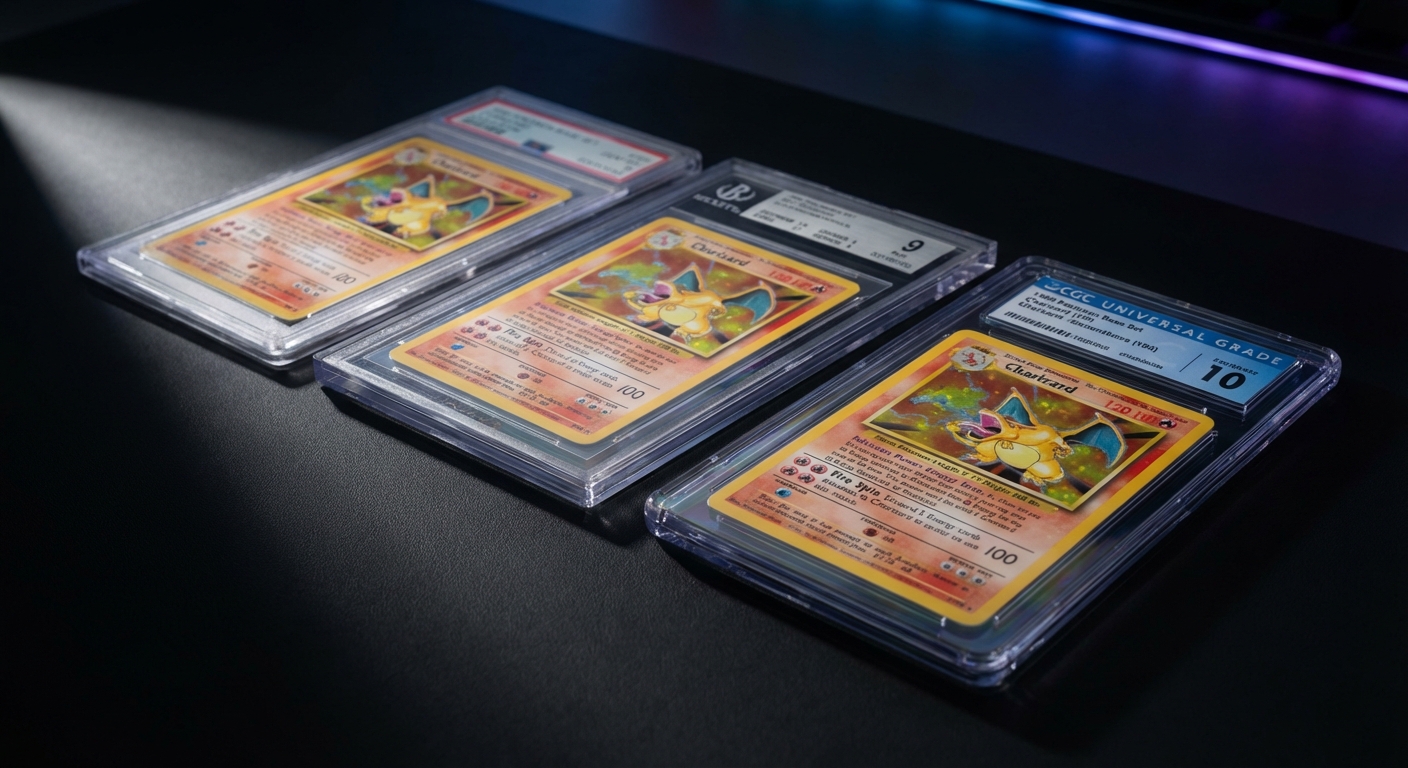
A PSA 10 Charizard sold for $420,000. The same card raw? Maybe $15,000. That plastic case represents a 28x multiplier.
The History of Pokemon Card Grading
Professional card grading began in the sports card industry during the 1990s, but Pokemon card grading remained a niche practice until the late 2010s. PSA graded their first Pokemon cards in 1999, the same year the Base Set launched in North America, but submission volumes were minimal. Most collectors kept their cards in binders or penny sleeves, unaware that condition preservation would become paramount decades later.
The COVID-19 pandemic fundamentally transformed the Pokemon card market. With people stuck at home, nostalgia-driven demand exploded. Logan Paul wearing a PSA 10 First Edition Charizard around his neck on YouTube sent shockwaves through the hobby. Suddenly, grading companies were overwhelmed with submissions. PSA temporarily closed to new submissions in 2021, with backlogs stretching beyond a year. This period established grading as the gold standard for high-value Pokemon cards.
Today, three companies dominate Pokemon card grading: PSA (Professional Sports Authenticator), BGS (Beckett Grading Services), and CGC (Certified Guaranty Company). Each has distinct standards, slab designs, and market perceptions. Choosing the right grading company—and understanding their criteria—can significantly impact your collection's value.
The Anatomy of Card Grading
Every grading company evaluates cards on four fundamental criteria: centering, corners, edges, and surface. However, the specific tolerances and weighting vary between companies. Understanding these factors is essential for pre-grading assessment.
Centering
Centering measures how evenly the printed image sits within the card's borders. A perfectly centered card has equal margins on all sides. Graders measure centering as a ratio—60/40 means one side has 60% of the border width while the opposite has 40%. PSA 10 requires 55/45 or better on the front and 75/25 on the back. BGS has even stricter requirements for their highest grades.
Pro tip: Vintage cards from 1999-2000 often have poor centering due to print quality control. Finding a well-centered vintage card is half the battle for achieving a high grade.
Corners
Corners are examined under magnification for any fraying, softness, or whitening. Even microscopic wear can drop a card from a 10 to a 9. Factory-fresh cards should have razor-sharp corners with no fiber lifting. Corner damage is cumulative—each of the four corners contributes to the overall assessment.
Edges
Edge evaluation looks for nicks, chips, chipping, and color breaks along all four card edges. Whitening—where the card's core shows through worn edges—is the most common flaw. Japanese cards, with their different card stock, often show edge wear differently than English cards.
Surface
Surface grading considers scratches, print lines, ink spots, dents, and holo scratching. Holographic cards are particularly susceptible to surface issues—the foil layer can scratch even from sleeve insertion. Print lines (factory defects where horizontal lines appear across the card) are common in certain sets and can affect grades.
PSA Grading Scale (1-10)
PSA (Professional Sports Authenticator) is the most recognized grading company for Pokemon cards. Founded in 1991, they've graded over 40 million cards across all categories. PSA evaluates cards on a 1-10 scale, with 10 being the highest possible grade. Their red-label slabs are instantly recognizable and command the highest liquidity in the market. centering, corners, edges, and surface.
| Grade | Name | Centering | Description |
|---|---|---|---|
| 10 | Gem Mint | 55/45 front, 75/25 back | A virtually perfect card. Corners are sharp to the naked eye. Focus must be clear. Full original gloss. Free of staining. No print defects. No breaks in surface ink. Slight printing imperfections are allowed if they don't impair the card's appeal. |
| 9 | Mint | 60/40 front, 90/10 back | A superb card with only one minor flaw that is only visible under close inspection. Corners are sharp to the naked eye with only one showing minor imperfection upon close inspection. |
| 8 | Near Mint-Mint | 65/35 front, 90/10 back | A super high-end card that appears Mint at first glance. May exhibit the slightest fraying at one or two corners. A slight printing imperfection is allowable. Slight wax staining acceptable on back only. |
| 7 | Near Mint | 70/30 front, 90/10 back | A card with just a slight surface wear visible upon close inspection. Corners may have slight fraying. Picture focus may be slightly off-register. A minor printing blemish is acceptable. Most of the original gloss retained. |
| 6 | Excellent-Mint | 75/25 front, 90/10 back | A card with visible surface wear or a printing defect not detrimental to the card's overall appearance. Some original gloss may be lost with no major scratches. |
| 5 | Excellent | 80/20 front, 90/10 back | A card that shows some noticeable flaws including one or more areas of the card that detract from the card's visual appeal. Minor rounding on corners. Slight scratching visible. |
| 4 | Very Good-Excellent | 85/15 front, 90/10 back | A card with some well-rounded corners. Visible surface wear. Some light scuffing on borders. Card may have light creases. |
| 3 | Very Good | 90/10 front, 90/10 back | A card showing obvious handling. Corners show significant wear with some rounding. May have some minor creases. Some gloss lost. |
| 2 | Good | 90/10 front and back | A card showing multiple handling flaws such as corner wear, creases, and surface scratches. Most gloss lost. |
| 1 | Poor | No minimum | A card with major defects. May have major creasing, staining, edge notches, rubber band marks, major discoloration, and/or heavy wear. May be missing a piece or portion of the card. |
Half-Point Grades
PSA Qualifiers
BGS Subgrades Explained
BGS (Beckett Grading Services) differentiates itself through its detailed subgrade system. Where PSA provides a single overall grade, BGS breaks down the evaluation into four individual scores displayed on the label. This transparency appeals to collectors who want to understand exactly why a card received its grade.
Centering
Measures front and back border symmetry. 10 requires 50/50 front, 55/45 back. 9.5 allows 55/45 front, 60/40 back. 9 permits 60/40 front, 65/35 back.
Corners
Evaluated under 10x magnification. Each corner is assessed individually. A 10 shows no visible wear. A 9.5 may have one corner with the slightest imperfection. A 9 may show minor wear on two corners.
Edges
Checked for chips, nicks, and color breaks. A 10 shows no visible flaws. A 9.5 may have a minor imperfection visible only under magnification. A 9 may show slight wear.
Surface
Examines both front and back for scratches, print lines, and defects. Holographic surfaces are scrutinized carefully. A 10 is flawless. A 9.5 may show the lightest scratching. A 9 may have minor surface issues.
BGS Special Grades
- —BGS 9.5 Gem Mint: The subgrades must average to 9.5 with no subgrade below 9. A card with four 9.5s earns a 9.5, as does a card with three 10s and a 9. This grade is often considered equivalent to PSA 10 and commands strong premiums.
- —BGS 10 Pristine: Requires all four subgrades to be 9.5 or higher, with an average of at least 10. Extremely difficult to achieve. These cards represent the top fraction of submissions.
- ★BGS 10 Black Label: The holy grail of Pokemon card grading. All four subgrades must be perfect 10s. The label background changes from gold to black, indicating this distinction. Black Labels on desirable cards can command 2-5x the price of a standard BGS 9.5.
The final BGS grade is not a simple average of subgrades. Beckett uses a proprietary formula that weights certain factors. A card with subgrades of 10/9.5/9.5/9.5 earns a 9.5, while 10/10/10/9 also results in 9.5. Understanding this formula helps collectors predict grades.
CGC Grading System
CGC (Certified Guaranty Company) entered the trading card market in 2020, leveraging decades of experience grading comic books and coins. They've quickly established themselves as a credible alternative to PSA and BGS, particularly attractive to collectors seeking faster turnaround times and competitive pricing.
CGC Grade Tiers
- —CGC 10 Gem Mint: A well-centered card with sharp corners, clean edges, and a pristine surface. This grade is more achievable than PSA 10 for pack-fresh cards due to slightly more lenient centering requirements.
- —CGC 10 Pristine: A higher distinction within the 10 grade. Requires near-perfect centering and flawless attributes across all categories. Cards earning this label show exceptional quality.
- ★CGC Perfect 10: The ultimate grade. Requires perfect 10s in all subgrade categories. Population is extremely low across all cards. These represent the absolute pinnacle of card condition.
PSA vs BGS vs CGC: Making the Right Choice
Choosing a grading company is a strategic decision that depends on your goals, the card in question, and market conditions. Here's a comprehensive comparison to guide your choice.
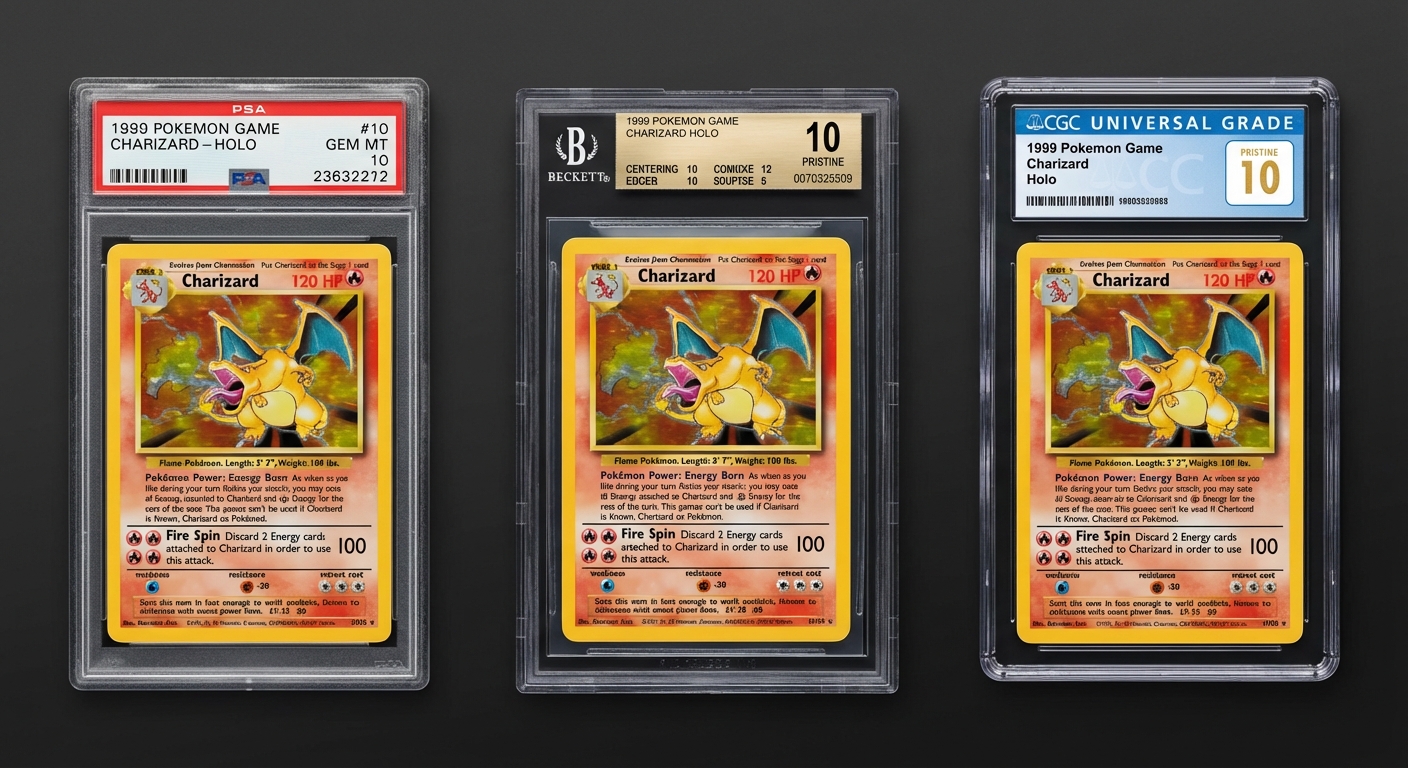
Best for resale value and liquidity. PSA's brand recognition means their slabs sell faster and often for higher prices, especially for vintage cards. If you plan to sell, PSA is usually the safest choice.
Best for collectors who value detailed grading information. The subgrade breakdown helps you understand exactly what affected the grade. BGS Black Labels command enormous premiums on high-value cards.
Best for modern cards and cost-conscious collectors. Faster turnaround, lower prices, and a growing reputation make CGC an excellent choice for grading modern sets or building a graded collection efficiently.
Crossover Grading: When and Why
Crossover grading involves submitting an already-graded card to a different company, hoping for a higher grade or different slab. This practice is common when collectors believe a card was undergraded or when market conditions favor a different company's label.
Consider crossover when: a BGS 9.5 might cross to PSA 10 (BGS 9.5 centering requirements are stricter), a CGC 10 could potentially earn PSA 10, or market dynamics shift to favor a particular company's labels.
Risks
Frequently Asked Questions
What does PSA 10 mean?
PSA 10 (Gem Mint) is the highest grade a Pokemon card can receive from PSA. It indicates a virtually perfect card with sharp corners, clean edges, pristine surface, and 55/45 centering or better on the front. Achieving a PSA 10 typically requires the card to be pack-fresh with no handling wear.
Is BGS 9.5 equal to PSA 10?
Many collectors consider BGS 9.5 roughly equivalent to PSA 10, as BGS has stricter centering requirements. A BGS 9.5 with strong subgrades (10/9.5/9.5/9.5) often crosses successfully to PSA 10. However, market perception varies—some buyers prefer PSA's brand recognition while others value BGS's detailed subgrades.
What are BGS subgrades and how do they work?
BGS provides four subgrades printed on every label: Centering, Corners, Edges, and Surface. Each is scored on a scale from 1 to 10. The final grade is calculated using a proprietary formula, not a simple average. Subgrades help collectors understand exactly which aspects of the card contributed to the overall grade.
Should I use CGC for Pokemon cards?
CGC is an excellent choice for modern cards, budget grading, or when you need faster turnaround. Their slabs are well-regarded, and their Perfect 10 designation commands strong premiums. However, for vintage cards or maximum resale value, PSA often remains the preferred choice due to market liquidity.
How do I know if a graded card is authentic?
All major grading companies offer verification services. PSA cards can be verified at PSAcard.com using the cert number. BGS cards are searchable at Beckett.com. CGC offers QR codes on their labels linking to verification. Always verify high-value purchases, as counterfeit slabs exist.
Check Graded Card Prices
Search our database for real-time PSA, BGS, and CGC graded Pokemon card prices. Compare values across grades and grading companies.
Browse Graded Prices→